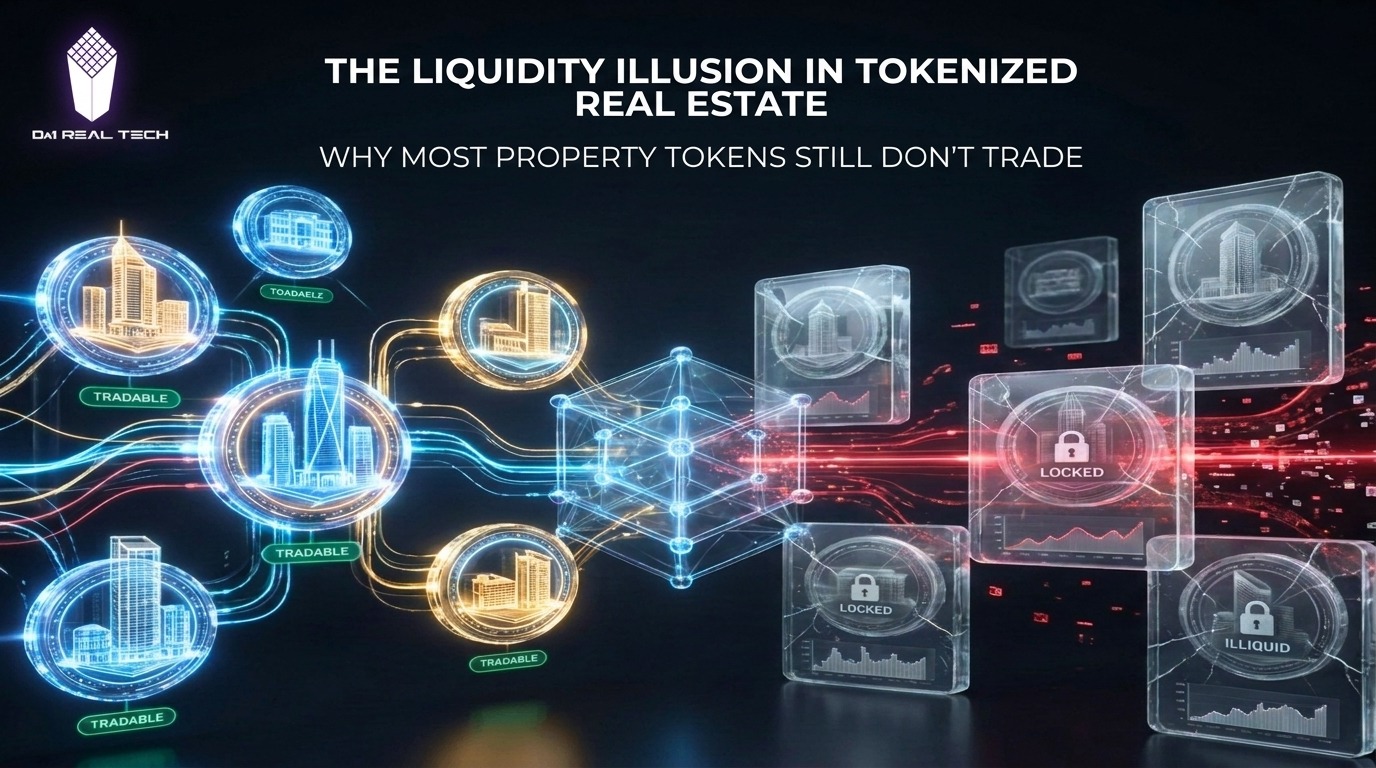
Everyone talks about tokenization. The investors who ask about liquidity are asking the better question. Discover why ownership without a practical exit strategy is only half a solution.
Everyone talks about tokenization. The investors who ask about liquidity are asking the better question.
Over the last few years, tokenized real estate has become one of the biggest stories in blockchain finance. The pitch is compelling: invest in premium global properties with a few clicks, own fractions of commercial real estate instead of buying an entire building, build an international property portfolio without crossing a border, and access opportunities that were once reserved for institutions and ultra-high-net-worth investors.
It sounds like the future of investing. But beneath all the excitement lies a question that many platforms rarely address: if you buy a tokenized property today, how easily can you sell it tomorrow?
That single question reveals the biggest weakness in today's Real-World Asset (RWA) market. Because while blockchain can digitize ownership, it cannot magically create liquidity, and for investors, ownership without a practical exit strategy is only half a solution.
One of the most common misunderstandings in blockchain real estate is the belief that putting a property on-chain automatically makes it liquid. It doesn't. Tokenization simply converts ownership rights into digital assets. Instead of purchasing an entire $20 million office building, investors can now buy smaller fractions represented by blockchain-based tokens.
This approach significantly lowers the barrier to entry, improves accessibility, and opens real estate investing to a global audience. However, accessibility should never be confused with liquidity. A property divided into 100,000 digital tokens may be easier to purchase than a traditional building, but that does not mean there is an active, ready market of buyers waiting when an investor wants to exit.
Without strong secondary markets and active trading infrastructure, tokenized ownership can quickly become little more than a digital representation of traditional illiquidity.
Real estate has never behaved like stocks or cryptocurrencies. Every property is fundamentally unique; location plays a critical role, rental performance varies widely, development potential differs from asset to asset, and local regulations further shape its value and attractiveness. Unlike publicly traded instruments, there is no universal marketplace where every property is continuously bought and sold in real time.
Several structural factors naturally limit liquidity in real estate markets:
High Capital Requirements — Even fractional ownership represents exposure to valuable assets, reducing transaction frequency compared to smaller financial instruments.
Limited Buyer Demand — An investor looking for exposure to a residential project in Dubai may have no interest in a commercial office development in Singapore. Real estate demand is highly specific.
Regulatory Complexity — Cross-border investing introduces securities laws, tax obligations, KYC requirements, and jurisdictional restrictions that vary around the world.
Slow Settlement Processes — Legal ownership transfers, compliance verification, and documentation still exist, even when blockchain technology simplifies record-keeping.
These challenges do not disappear simply because ownership is represented digitally.
Blockchain technology has introduced genuine improvements to the real estate industry. It enables fractional ownership, greater transparency, more efficient record management, global investor participation, and lower barriers to entry. These are meaningful innovations.
But tokenization alone does not solve: secondary market liquidity, continuous price discovery, reliable exit opportunities, or deep buyer and seller participation.
Creating digital ownership without creating an active marketplace is like opening a stock exchange with no traders. The technology works. The market does not.
Many tokenized real estate projects tend to follow a familiar pattern. A property is listed, investors purchase tokens, and the blockchain accurately records ownership. The initial fundraising is often successful, creating the impression of strong market demand. However, once the offering closes, trading activity typically begins to slow. Days turn into weeks, and weeks into months, with very few secondary transactions taking place.
In the end, the asset remains on-chain, but its behavior resembles traditional real estate more than a liquid financial instrument. Ownership becomes digital, but liquidity does not follow. This is the reality many investors are now beginning to recognize as the liquidity illusion: the industry has succeeded in digitizing ownership, but it has not yet solved the challenge of movement.
The next stage of real estate innovation is not creating more tokens. It is building the infrastructure that allows those tokens to move efficiently between investors. True liquidity requires far more than blockchain technology alone.
Active Secondary Markets — Investors need trusted environments where ownership interests can be bought and sold after the initial offering.
Continuous Price Discovery — Healthy markets depend on transparent valuation mechanisms that help buyers and sellers agree on fair value.
Global Capital Access — The larger the pool of qualified investors, the stronger and more resilient market activity becomes.
Automated Compliance — Modern markets require KYC, AML, and regulatory compliance to operate seamlessly without creating unnecessary friction.
Deep Liquidity Pools — Reliable access to buyers and available capital is what ultimately gives investors the confidence to enter and exit positions without hesitation.
When these elements work together effectively, they define what we believe is the next frontier of blockchain real estate: liquidity engineering.
Fractional ownership opened the door, but liquidity determines whether investors will actually walk through it. Institutional investors, family offices, and other sophisticated market participants don't evaluate opportunities based on potential returns alone; they also look closely at flexibility. They ask whether capital can move efficiently, whether positions can be adjusted as market conditions change, and whether they can exit without waiting months for the right buyer.
In the long run, the success of tokenized real estate will depend less on how many assets are brought on-chain and far more on how effectively those assets can circulate within global financial markets.
The first generation of blockchain real estate has already proven that ownership can be digitized. The next generation, however, must go a step further and demonstrate that ownership can actually move. The platforms that succeed in solving this challenge will not just launch another investment product; they will build the underlying infrastructure that connects real estate to the speed, efficiency, and accessibility of modern financial markets.
In many ways, liquidity will become the defining innovation that determines whether tokenized property remains an experimental concept or evolves into a truly mature global asset class.
At DA1 RealTech, we believe the conversation around tokenized real estate must go beyond simple fractional ownership. Digitizing property is only the starting point, not the end goal. The real challenge and the real opportunity lies in building the infrastructure that allows value to move freely across markets.
Liquidity should not be treated as an afterthought added on top of tokenization; it needs to be designed into the system from the very beginning. Because ownership without liquidity only limits opportunity. But when ownership is paired with transparent, compliant, and efficient market infrastructure, it has the potential to fundamentally reshape how the world invests in real estate.
Blockchain has already transformed the way the world thinks about property ownership, making it possible to divide, digitize, and access real estate investments like never before. But the next chapter of this evolution isn't about creating more tokens; it's about creating movement.
The platforms that shape the next decade won't necessarily be those that tokenize the most buildings; they'll be the ones that solve the industry's biggest challenge: liquidity. After all, investors aren't simply looking for a digital certificate of ownership; they're looking for the confidence that they can enter and exit opportunities when the market demands it.
In the future of real estate, value won't be defined by what sits on a blockchain ledger, but by how efficiently it can flow through a global financial ecosystem.
Da1 RealTech
Editorial Team